

Professor George Monray on Global GDP End-Use Forecasts and Sensitivity Analysis
News originally published by
EIN Presswire
George Monray
Mathematical Certainties
US Mathematical Certainties
Exclusive interview with the study's author, **Professor George Monray**, discussing key empirical discoveries, and global policy implications of this research.
BANGKOK, THAILAND, November 5, 2026 /EINPresswire.com/ -- A landmark economic study titled "Certainties and Sensitivity Analysis of the Global Economy: A GDP by end-use approach" published at The Journal of Global Economics & Sustainable Development (JGESD) provides a comprehensive quantitative forecast for the world's leading economies heading into 2030.
By evaluating the four foundational end-use components of Gross Domestic Product—Household Consumption, Government Spending, Exports, and Imports—the research models economic trajectories, measures forecasting uncertainties, and isolates the primary drivers of macroeconomic volatility across forty top nations accounting for over 90 percent of global GDP.
Below is an exclusive interview with the study's author, Professor George Monray, discussing the methodology, key empirical discoveries, and global policy implications of this research.
Professor Monray, what inspired you to conduct this comprehensive global GDP end-use study, and why focus specifically on the top 40 economies?
George Monray: Standard aggregate Gross Domestic Product figures frequently mask underlying structural vulnerabilities within national economies. A country's top-line growth rate might appear robust on paper, but if that expansion is driven primarily by unsustainable government spending or debt-fueled consumption, it carries vastly different long-term stability implications than growth powered by export competitiveness or capital investment. We selected the top forty economies—with Hong Kong and Pakistan added and Nigeria omitted due to end-use data gaps—because they collectively represent 90.3 percent of total global output as of late 2024. Analyzing how end-use components evolve across these specific nations gives us a clear window into the future trajectory of nine-tenths of the world economy.
Your research combines historical longitudinal data with advanced statistical modeling. Could you explain the methodology behind your 2030 forecasts and Monte Carlo simulations?
George Monray: The research design integrates three distinct analytical stages. First, we compiled a dataset of 14,184 data points spanning 50 to 60 years of historical data from the 1960s through 2023 for each end-use variable. Second, we applied mathematical linear regression techniques to project Household Consumption, Government Spending, Exports, and Imports out to 2030, while incorporating baseline IMF investment forecasts.
Finally, to evaluate real-world uncertainty, we executed rigorous Monte Carlo simulations. We assigned triangular probability distributions across lower, expected, and upper forecast bounds for each variable. Running 20,000 random iterations per variable across forty countries under a 99 percent confidence level yielded 3.2 million total simulations. This extensive computational framework allowed us to calculate precise statistical probability distributions for each country's GDP baseline.
What emerged as the single most significant finding regarding what drives global economic volatility?
George Monray: The single most striking discovery was the overwhelming impact of international trade components on overall GDP variance. Across the global model, imports surfaced as the most sensitive factor contributing to GDP dispersion, acting as the primary volatility driver in 60 percent—or 24 out of 40—of the nations analyzed. Exports closely followed, serving as the leading sensitivity variable in 57.5 percent—or 23 out of 40—of national economies.
By contrast, domestic Household Consumption proved to be the primary sensitivity factor in only 20 percent—or 8—of the analyzed nations. Most notably, Government Spending demonstrated zero structural sensitivity across the model. This demonstrates empirically that adjusting trade balance factors is far more critical to macroeconomic stability than domestic fiscal expansion.
Your study reveals stark differences in economic certainty across different geographic regions. Which nations show high stability versus high vulnerability?
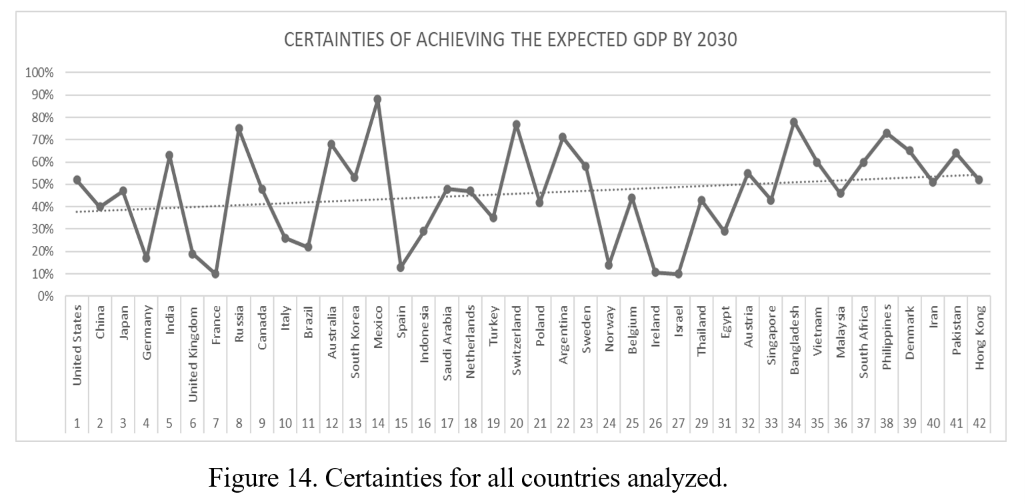
George Monray: Our Monte Carlo certainty analysis revealed significant geographic divergence. Major European economies and the United Kingdom exhibit low statistical probabilities—under 40 percent—of achieving their baseline 2030 GDP projections, highlighting severe vulnerability to trade shifts. Germany, France, Italy, Spain, and the UK are heavily exposed due to high sensitivity in their import and export balances.
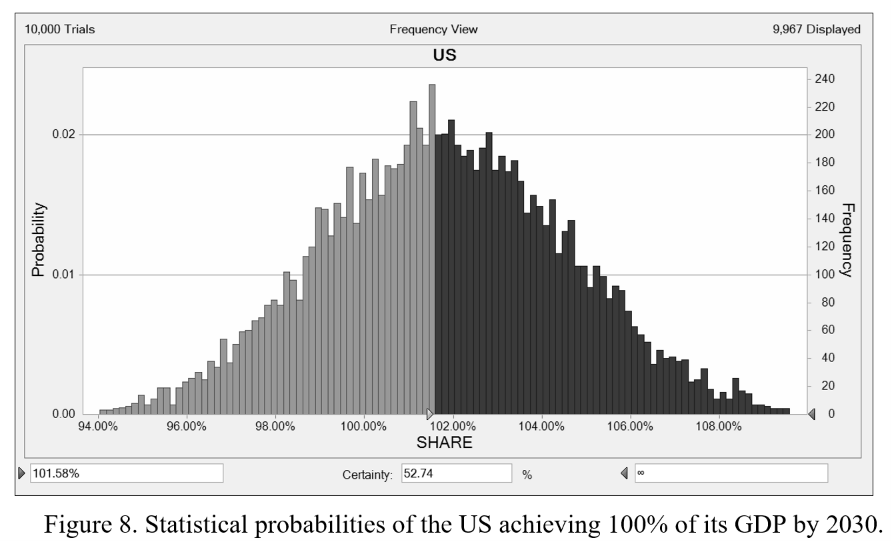
Conversely, countries like Mexico, Russia, Switzerland, Argentina, Bangladesh, and the Philippines demonstrated high statistical certainties exceeding 70 percent. Meanwhile, the world's two largest economies—the United States and China—fall into a moderate uncertainty bracket between 40 and 69 percent, but due to fundamentally different structural dynamics.
Could you elaborate on that structural contrast between the United States and China?
George Monray: The US and China present fascinating contrasting profiles. In China, Household Consumption accounts for 73 percent of total outcome variance, whereas exports account for 13.8 percent and imports 11.7 percent. This heavy domestic consumption weighting insulates China's broader GDP growth from external trade war shocks. In the United States, Household Consumption comprises nearly 70 percent of total GDP weight and 39.6 percent of variance, while imports represent a massive -45 percent sensitivity impact on trade balance drag. While the US remains consumer-driven, its rising import reliance creates structural trade vulnerability that policymakers must actively address.
Based on these findings, what strategic policy recommendations do you offer to global finance ministers?
George Monray: Economic leaders must reorient their focus toward trade balance optimization and external vulnerability reduction. Because import dependencies generate substantial economic volatility across European and Asian trade blocks, policymakers facing growth shortfalls will likely feel pressure to enact protective tariff policies or supply chain reshoring initiatives. However, unilateral trade barriers risk destabilizing partner economies. Finance ministries must balance domestic consumption incentives with targeted export competitiveness strategies, ensuring that national growth is anchored in sustainable productivity rather than volatile net trade deficits.
About Professor George Monray
George Monray is a professor of microeconomics at IAU Barcelona specializing in global trade modeling, business administration and econometric forecasting. Author of the book US-China global supremacy: 2030 economic forecast.
George Monray
GM
george@gmonray.com
Visit us on social media:
LinkedIn
Legal Disclaimer:
EIN Presswire provides this news content "as is" without warranty of any kind. We do not accept any responsibility or liability for the accuracy, content, images, videos, licenses, completeness, legality, or reliability of the information contained in this article. If you have any complaints or copyright issues related to this article, kindly contact the author above.
