

Shipbuilding Market Poised to Hit US$ 500.63 Billion by 2035, Fueled by Digitalization, Trade, and Naval Investments
Shipbuilding Market
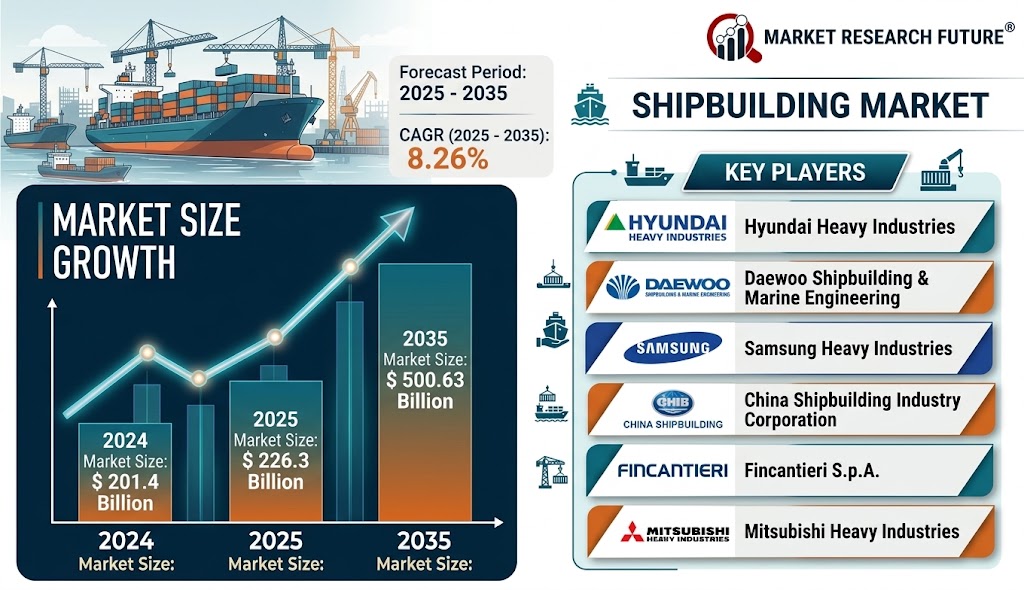
Global shipbuilding market was valued at US$ 226.3 billion in 2025 to US$ 500.63 billion by 2035, registering a CAGR of 8.26% from 2025-2035
NEW YORK, NY, UNITED STATES, August 24, 2026 /EINPresswire.com/ -- The industry is undergoing a transformation in vessel design, production methods, materials, and technologies. Shipbuilders are increasingly integrating automation, artificial intelligence, Internet of Things technologies, digital modeling, and other advanced solutions to improve operational efficiency, optimize designs, reduce construction timelines, and support more sustainable vessel development. At the same time, demand from commercial shipping remains strong, while defense-related shipbuilding is gaining momentum.The market is also benefiting from the expansion of maritime capabilities in emerging economies. Growing investments in maritime infrastructure, increasing international trade activities, and demand for modern cargo and defense vessels are creating new opportunities for shipyards and technology providers. The Asia-Pacific region remains a major center of global shipbuilding activity, while North America and Europe continue to maintain significant positions through established maritime industries, advanced facilities, and investments in innovation.
Request for Free Sample of Report: https://www.marketresearchfuture.com/sample_request/10314
Market Trends:
Sustainability has become one of the most important trends influencing the Shipbuilding Market. Shipbuilders are increasingly adopting eco-friendly materials and technologies designed to minimize environmental impact. The focus on greener vessel construction reflects changing environmental requirements and the industry's broader efforts to reduce carbon footprints. Technologies supporting more efficient vessels are becoming increasingly important as manufacturers adapt vessel designs to evolving sustainability expectations.
Digital transformation is another major trend. Digital shipbuilding is enabling companies to incorporate advanced technologies into design and construction activities. Artificial intelligence and the Internet of Things are being integrated to improve operational efficiency, optimize design processes, and enhance maintenance practices. Simulation, 3D modeling, and data analytics are also supporting better decision-making and collaboration throughout the construction lifecycle.
The expansion of emerging maritime markets is also influencing the competitive environment. Countries with growing economies are investing in maritime infrastructure and expanding their capabilities, increasing demand for new vessels. This expansion is encouraging established shipbuilders to strengthen their market presence while creating opportunities for new participants.
Another important trend is the increasing use of automation and advanced production technologies. Robotics and digital tools are helping streamline assembly and improve precision. Modular construction is also becoming relevant as shipbuilders seek to enhance efficiency and reduce turnaround times. The convergence of digital technologies and sustainability is expected to remain a defining characteristic of the industry through the forecast period.
Market Drivers:
One of the primary factors supporting the Shipbuilding Market is increasing global trade and maritime activity. Expansion of shipping routes, port development, and growing demand for maritime logistics create a continuing requirement for new vessels. Commercial shipping remains a significant contributor because cargo and container vessels play an essential role in international trade and supply chains.
The increasing demand for eco-friendly vessels is another important growth factor. Environmental considerations are encouraging shipbuilders to adopt technologies such as LNG propulsion and hybrid systems. The shift toward cleaner vessel technologies is influencing ship design and encouraging manufacturers to develop solutions that improve energy efficiency and reduce environmental impact.
Technological advancement is also accelerating industry development. Automation, digital twin technology, advanced materials, simulation, and robotics are helping shipbuilders improve productivity and vessel performance. Digital tools can optimize design and simulation activities, while robotics can improve assembly precision and production timelines. These advancements are encouraging investments in modern shipbuilding capabilities.
Growing demand for defense and naval vessels represents another significant driver. Geopolitical tensions and increasing attention to maritime security are prompting countries to strengthen naval capabilities. The resulting demand for warships, submarines, and support vessels is creating additional opportunities for defense-oriented shipbuilders. Government investments in maritime infrastructure further support production capacity, innovation, and development of modern shipyard facilities.
Market Opportunities:
The future outlook presents considerable opportunities for participants in the Shipbuilding Market. One of the most prominent opportunities is the development of autonomous ship technology. Investments in advanced automation can help shipbuilders address changing operational requirements while creating new capabilities in vessel design and construction.
Green shipbuilding represents another important opportunity. Increasing demand for eco-friendly vessels is encouraging manufacturers to explore sustainable technologies and materials. Shipbuilders that can combine environmental performance with operational efficiency may be better positioned to respond to changing customer requirements.
Digital twin technology also offers significant potential. The integration of digital twins into design and construction can support simulation, collaboration, performance optimization, and decision-making. Partnerships between shipbuilders and technology providers could accelerate adoption and strengthen innovation across the industry.
Emerging markets provide additional opportunities as countries expand maritime infrastructure and capabilities. Increasing investment in new vessels, shipyards, and related infrastructure can support market expansion while creating opportunities for both established companies and new entrants.
Segmental Analysis:
1. By Ship Type
The Shipbuilding Market can be analyzed by ship type into Cargo, Vessel, Container, Tanker, Multi-Purpose Ship, Car and Passenger Ferry, and Others.
Cargo ships represent a dominant category because of their essential role in international trade and logistics. Their ability to transport large volumes of goods makes them an important component of global supply chains. Continued development of freight networks and maritime trade supports demand for cargo ships.
Tankers are also an important category and are identified as an emerging, rapidly expanding vessel type in the source analysis. They are used to transport liquid commodities, including crude oil, chemicals, and liquefied natural gas. Increasing demand and changing environmental requirements are influencing tanker design and encouraging greener technologies.
Container vessels remain closely connected to international trade and logistics, while multi-purpose ships serve diverse transportation requirements. Car and passenger ferries address transportation needs involving vehicles and passengers. Other specialized vessel categories contribute to the industry's ability to address specific maritime requirements.
2. By Process
Based on process, the market includes Designing, Production Planning, Cutting and Processing, Assembling and Launching, and Outfitting.
Designing is becoming increasingly technology-oriented as shipbuilders adopt simulation, 3D modeling, digital tools, and advanced analytics. These technologies can support optimized vessel designs and improve collaboration.
Production planning plays an important role in coordinating resources and improving manufacturing efficiency. Cutting and processing activities are increasingly supported by automation and robotics, which can improve precision and streamline production.
Assembling and launching represent critical stages in vessel construction, with automation and modular approaches helping improve efficiency. Outfitting completes essential vessel systems and equipment before delivery. Across these processes, digitalization is contributing to improved coordination, productivity, and construction timelines.
3. By End User
The market is segmented into Commercial and Military end users.
The commercial segment remains dominant, supported by international trade and demand for cargo and container ships. Commercial shipping represents a substantial share of demand because businesses require efficient maritime transportation solutions for global logistics.
The military segment is experiencing increasing momentum as countries strengthen maritime security and naval capabilities. Demand for advanced naval vessels, warships, submarines, and support vessels is supported by geopolitical considerations and government investments. The increasing importance of naval vessels is therefore contributing to the expansion of the military segment.
Regional Analysis:
1. North America - North America represents an established regional market, with the region's shipbuilding industry valued at USD 40.28 billion, according to the source. Demand is supported by commercial shipping activity, naval vessel requirements, offshore support ships, government support, and defense spending. The region also benefits from established shipbuilding facilities and increasing interest in innovation and sustainability.
2. Europe - Europe's market was valued at USD 35.42 billion. The regional industry has a strong emphasis on sustainability and technological innovation. Germany, Italy, and Spain are identified as important contributors, while government initiatives and collaborations between public and private sectors support research and development. The European market is also responding to environmental requirements through increased attention to eco-friendly vessels and green technologies.
3. Asia-Pacific - Asia-Pacific is the leading regional market, with a valuation of USD 125.0 billion. China, South Korea, and Japan are pivotal markets supported by industrialization, trade activities, government policies, and investments in advanced shipbuilding technologies. The region benefits from substantial production capabilities and technological development, enabling it to meet global vessel demand. The source also identifies Asia-Pacific as the fastest-growing regional market, supported by increasing demand for defense and cargo vessels.
4. Rest of the World - The Rest of the World includes emerging markets where maritime capabilities and infrastructure are developing. The Middle East and Africa market, valued at USD 0.7 billion, remains at an early stage but offers growth potential. Increasing investment in infrastructure, naval and commercial vessels, shipyards, and workforce development could support gradual expansion in these markets.
Competitive Landscape and Company Profiles:
The competitive environment of the Shipbuilding Market is characterized by established global companies and emerging participants competing through technological innovation, sustainability, production capabilities, and strategic expansion. The market is described as moderately fragmented, with companies increasingly emphasizing technology, supply-chain reliability, and sustainable practices rather than relying solely on price competition.
Major companies profiled in the report include Hyundai Heavy Industries, Daewoo Shipbuilding & Marine Engineering, Samsung Heavy Industries, China Shipbuilding Industry Corporation, Fincantieri S.p.A., Mitsubishi Heavy Industries, Navantia, General Dynamics, and Thyssenkrupp Marine Systems.
Hyundai Heavy Industries is focusing on innovation and digital transformation, including smart ship technologies and automation. Daewoo Shipbuilding & Marine Engineering is emphasizing strategic partnerships and high-value defense projects. China Shipbuilding Industry Corporation is expanding its presence through regional expansion and localization strategies.
Fincantieri and Thyssenkrupp Marine Systems are important European participants, while Mitsubishi Heavy Industries contributes to the competitive landscape in Japan. General Dynamics represents an important North American participant. Together, these companies illustrate the global nature of the industry and the importance of innovation, advanced manufacturing, and strategic collaboration.
Recent Developments:
November 2026: Hyundai Heavy Industries announced a partnership with a leading technology firm to develop AI-driven predictive maintenance systems for vessels. The initiative reflects the growing integration of artificial intelligence into ship maintenance and is intended to enhance operational reliability and reduce downtime.
October 2026: Daewoo Shipbuilding & Marine Engineering secured a significant contract with a European naval force for the construction of advanced submarines. The development highlights the company's capabilities in defense shipbuilding and its focus on high-value projects.
September 2026: China Shipbuilding Industry Corporation unveiled plans to invest USD 500 million in a new shipyard dedicated to green technologies. The initiative reflects the industry's increasing emphasis on sustainable shipbuilding and the development of environmentally focused production capabilities.
December 2026: The market was characterized by a pronounced shift toward digitalization, sustainability, and artificial intelligence integration. Strategic alliances increasingly shaped the competitive landscape, with technological advancement, supply-chain reliability, and sustainable practices becoming increasingly important sources of competitive differentiation.
Conclusion:
The global Shipbuilding Market is positioned for substantial expansion through 2035. From USD 201.4 billion in 2024, the market is expected to reach USD 500.63 billion by 2035, advancing at a CAGR of 8.26% between 2025 and 2035.
The industry's evolution is being shaped by digital transformation, sustainability, automation, emerging maritime markets, expanding global trade, and increasing defense requirements. Cargo ships continue to represent an important vessel category, while tanker demand is emerging strongly. Commercial applications remain dominant, whereas military demand is gaining momentum.
Future opportunities are expected to center on autonomous ship technology, green shipbuilding, advanced automation, sustainable materials, and digital twin integration. With Asia-Pacific maintaining its global leadership, North America and Europe retaining strong established positions, and emerging markets developing their maritime capabilities, the industry is expected to remain an important component of global transportation, logistics, defense, and maritime infrastructure.
As shipbuilders continue to invest in technology, sustainability, and production capabilities, the competitive environment is likely to become increasingly innovation-focused. Companies capable of integrating digital technologies with efficient and sustainable vessel construction will be well positioned to participate in the industry's projected long-term expansion.
Browse More Reports:
Airship Market
https://www.marketresearchfuture.com/reports/airship-market-29068
Autonomous Ships Market
https://www.marketresearchfuture.com/reports/autonomous-ships-market-8103
Connected Ship Market
https://www.marketresearchfuture.com/reports/connected-ship-market-8092
Sagar Kadam
Market Research Future
+1 628-258-0071
sales@marketresearchfuture.com
Legal Disclaimer:
EIN Presswire provides this news content "as is" without warranty of any kind. We do not accept any responsibility or liability for the accuracy, content, images, videos, licenses, completeness, legality, or reliability of the information contained in this article. If you have any complaints or copyright issues related to this article, kindly contact the author above.
